
How to Read Your Withholding Slip (Gensen Choshuhyo)
If you live in Japan and earn a salary, each employer that pays you in Japan gives you a withholding slip (gensen choshuhyo) for the year. You generally get it by the end of the following January. Start with the four boxes in its top row: payment amount, amount after the employment income deduction, total deductions, and tax withheld.
If the middle two boxes are blank, that employer did not settle your tax through a year-end adjustment (nenmatsu chosei). If you changed jobs, first check your new employer's slip, because it may already include this pay. If not, you may get tax back by filing a final tax return (kakutei shinkoku), or you may have to file one.
When your slip arrives
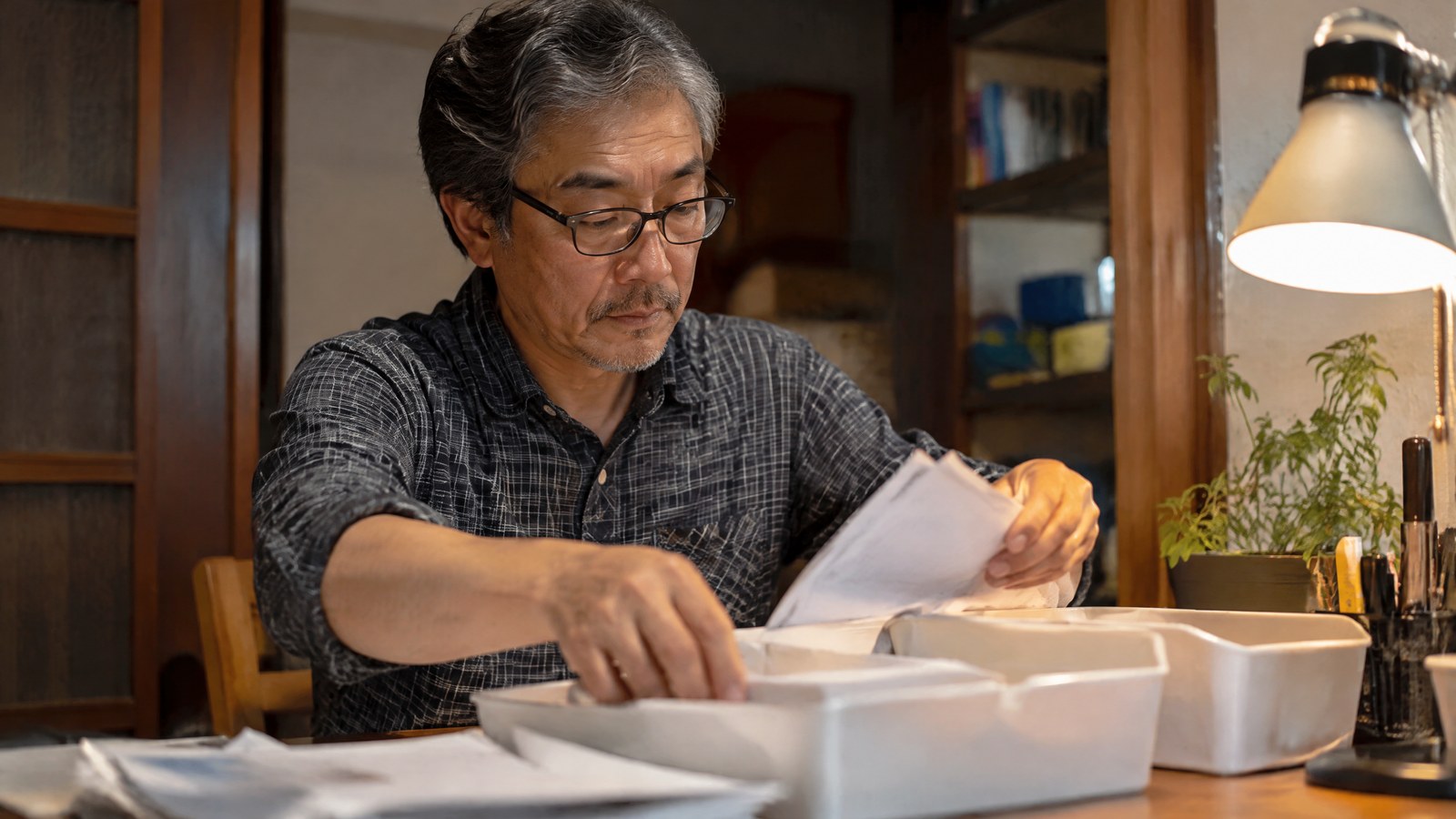
An employer that pays you a salary in Japan generally must give you a slip for the year by January 31 of the next year. For tax year 2026 (Reiwa 8), the National Tax Agency (NTA) gives the date as February 1, 2027 (January 31 is a Sunday). If you leave a job, your employer must give you the slip within one month after you leave.
Your employer may provide it electronically with your consent. If you do not reply to your employer's notice by its deadline, you may be treated as agreeing. It must still give you paper if you ask. The NTA says the copy you receive keeps its current layout.
This guide is for tax residents of Japan. The slip is in Japanese, so we give each box an English name and its romaji.
The four boxes in the top row
The four key figures sit in the top row, after the type of pay.
- Type of pay (shubetsu). For example, salary and bonus.
- Box 1. Payment amount (shiharai kingaku). Your gross salary and bonuses for the year, before tax and social insurance.
- Box 2. Amount after the employment income deduction (kyuyo shotoku kojo-go no kingaku). Box 1 minus a standard deduction for employees, which gives your employment income.
- Box 3. Total deductions (shotoku kojo no gaku no gokei-gaku). The deductions your employer applied, such as social insurance, life insurance, family deductions and the basic deduction.
- Box 4. Tax withheld (gensen choshu zeigaku). National income tax, including the 2.1% special income tax for reconstruction.
Your employer fills in Boxes 2 and 3 only if it did your year-end adjustment. With pay over ¥8.5 million and, for example, a dependent under 23, Box 2 also subtracts an income adjustment deduction.
After a job change, Box 1 may include pay from your old employer. The remarks box (tekiyo) then names that employer.
Lower down, the slip lists some deductions one by one, such as social insurance (shakai hokenryo-to no kingaku). Check boxes at the bottom show facts such as column B (otsu-ran), and the date you joined or left.
A small figure after uchi (of which) is part of the main figure, not an extra amount. In Box 1, it is pay not yet paid. In Box 4, it is tax not yet withheld. In the social insurance box, it is iDeCo and similar contributions.
Blank boxes: your year may not be settled
If Boxes 2 and 3 are blank, the employer that issued the slip did not do your year-end adjustment. Box 4 is then only the tax withheld from each payment, not your tax for the year.
Year-end adjustment done
- Boxes 2 and 3 are filled in
- Box 4 is the year's tax on this pay, as your employer worked it out
- A return may still be needed for other income, or useful for more deductions
No year-end adjustment
- Boxes 2 and 3 are blank
- Box 4 is only the tax withheld
- Unless another slip covers this pay, filing may get tax back, or may be required
If you changed jobs, check your new employer's slip first. If no slip includes the pay, find your reason below:
- You left during the year. You may get tax back with a refund return.
- Your pay was over ¥20 million. You generally must file a return.
- It is your second job. The column B box is marked. See two employers.

If Box 4 shows ¥0, there is no income tax from that slip to refund.
Example: tracing Box 4 on Maria's slip
After a year-end adjustment, Box 2 minus Box 3 gives the taxable income your employer used, and the tax on it leads to Box 4. Maria is single, worked for one employer all of 2026 and had her year-end adjustment in December.
| Step | Amount |
|---|---|
| Box 1. Payment amount | ¥6,000,000 |
| Employment income deduction: ¥6,000,000 × 20% + ¥440,000 | −¥1,640,000 |
| Box 2. Amount after the deduction | ¥4,360,000 |
| Box 3. Total deductions: ¥900,000 social insurance + ¥1,040,000 basic deduction | ¥1,940,000 |
| Taxable income: Box 2 − Box 3 | ¥2,420,000 |
| Income tax: ¥2,420,000 × 10% − ¥97,500 | ¥144,500 |
| Box 4. ¥144,500 × 102.1%, rounded down to the nearest ¥100 | ¥147,500 |
This is only an estimate, based on these assumptions: 2026 amounts from December 1, 2026, and no other income, deductions or credits. From tax year 2027, a new defense special income tax starts and the reconstruction rate falls, with no change in the combined rate.
A deduction your slip leaves out can mean a refund. Suppose Maria also paid ¥250,000 of medical bills in 2026, with nothing reimbursed. Her medical expense deduction would be ¥150,000 (¥250,000 − the ¥100,000 threshold).
On a refund return, her taxable income falls to ¥2,270,000. Her tax becomes ¥132,219 (¥129,500 plus ¥2,719 for reconstruction). So ¥15,281 (¥147,500 − ¥132,219) may be refunded after she files. This is only an estimate, based on the same assumptions.
Check what your slip leaves out
Your slip shows only the pay and deductions that your employer handled. Look for these gaps:
- Pay your employer did not handle, such as stock pay from a foreign parent or pay received abroad. You may have to file.
- Side or rental income. Over ¥200,000, you generally must file. See the ¥200,000 rule.
- Deductions a year-end adjustment cannot include, such as medical expenses, donations, casualty losses and the first year of the housing loan credit. To claim them for income tax, you file a return.
- Family abroad. A box shows how many family members on your slip are non-residents (hikyojusha de aru shinzoku no kazu). See dependents abroad for the documents.

If a figure looks wrong, ask your employer's payroll team first.
Common mistakes
- Reading Box 4 as a refund. It is tax you paid, not tax coming back.
- Using take-home pay. Tests such as the ¥20 million line use Box 1, your gross pay.
- Treating two slips separately. With two or more slips for a year, the employment income deduction applies once, to their total payment amount. Do not count the same pay twice.
- Throwing the slip away. You need its figures to file. A refund return can be filed for five years from January 1 of the next year.
What you can do yourself, and where you need help
You can check your slip yourself:
- Match Box 1 with your payslips, including bonuses.
- See whether Boxes 2 and 3 are filled in.
- List any income and deductions that are not on the slip.

With one slip and a simple claim, you may be able to file yourself. The NTA's online tool is in Japanese, with an English input guide. For a slip with no year-end adjustment, the guide shows you entering Box 1, Box 4, social insurance and your employer's details.
You need help when the answer depends on your facts. Examples are pay from abroad, stock pay, family abroad and years you did not file.
What changes when a tax accountant handles it
Komatsu CPA & Tax Accounting Office helps individuals only, with Japanese tax only, and offers no calls. Our service runs by email in written English. Once you engage us, we:
- Read your slips and confirm in writing whether you must file or may get a refund.
- Add the income and deductions that your slips leave out.
- Prepare the Japanese return and send an English summary for your approval.
- Sign and file the return, then send you the filed copy.
Take a return with one slip, standard deductions and a medical expense claim. Our English-language service items add up to ¥75,000 (¥48,000 base + ¥9,000 salary + ¥9,000 standard deductions + ¥9,000 medical expense deduction). That is below our minimum, so the fee is ¥105,000 (¥115,500 including tax). For a small refund like Maria's, filing yourself may suit you better. This is only an estimate, based on the assumptions shown.
Frequently asked questions
Does the tax withheld box include resident tax?
No. It shows national income tax, including the 2.1% special income tax for reconstruction. Resident tax (juminzei) is a separate local tax, collected by your city, town or ward.
Do I attach my slip to my tax return?
No. You do not need to attach it to your return or show it. You copy its figures into the return, so keep the slip.
I changed jobs and have two slips. Do I add both?
Check the new slip first. If your new employer included your old pay in its year-end adjustment, its Box 1 already contains that pay. Its remarks box then names your old employer. Do not add the old slip again. If it did not, enter both slips on your return.
Box 4 on my slip shows ¥0. Can I get a refund?
Not from that slip. A refund can only return income tax that was withheld or prepaid. If Box 4 shows ¥0, there is no income tax from that pay to give back.
Not sure what your slip means for your return?
Yuma Komatsu is a Japanese CPA and licensed tax accountant. We prepare, sign and file your return. We work by email in written English. Our tax accountant does not speak English, and we do not offer calls.
Sources
- NTA procedure F1-1 (in Japanese): the employment income withholding slip, its forms and instructions
- NTA guide to withholding slips and other statutory reports for 2026 (in Japanese): chapter 2, and page 35 on electronic delivery
- NTA: 2025 Income Tax and Special Income Tax for Reconstruction Guide, pages 11, 12, 47, 48 and 66
- NTA: You can create a Final Tax Return at Home! (English input guide for the online tool, 2025 edition), pages 14 to 16
- NTA: deductions for employees for 2026 (English leaflet)
- NTA guide to the 2026 year-end adjustment (in Japanese): pages 35 to 39, and the table on pages 47 to 54
- NTA Tax Answer No.2665 (in Japanese): who receives a year-end adjustment
- NTA Tax Answer No.2030 (in Japanese): refund returns
- NTA Tax Answer No.1410 (in Japanese): employment income deduction
- NTA Tax Answer No.1199 (in Japanese): basic deduction
- NTA Tax Answer No.2260 (in Japanese): income tax rates, and the defense special income tax from 2027
- NTA Tax Answer No.1120 (in Japanese): medical expense deduction
- Income Tax Act, Articles 190 and 226 (in Japanese)
This article is general information based on rules in force as of November 23, 2026. It is not advice for your situation.