
The Medical Expense Deduction in Japan: What Counts
You can deduct medical costs you paid during the year for yourself and for family members who share your budget. Subtract insurance payouts, then ¥100,000. The rest, up to ¥2 million, is your deduction. If your total income is under ¥2 million, subtract 5% of it instead of ¥100,000.
Treatment counts, including treatment abroad. Health checks, vitamins and cosmetic treatment generally do not. Employees claim it on a final tax return (kakutei shinkoku), because the year-end adjustment (nenmatsu chosei) cannot include it.
What counts as a medical expense
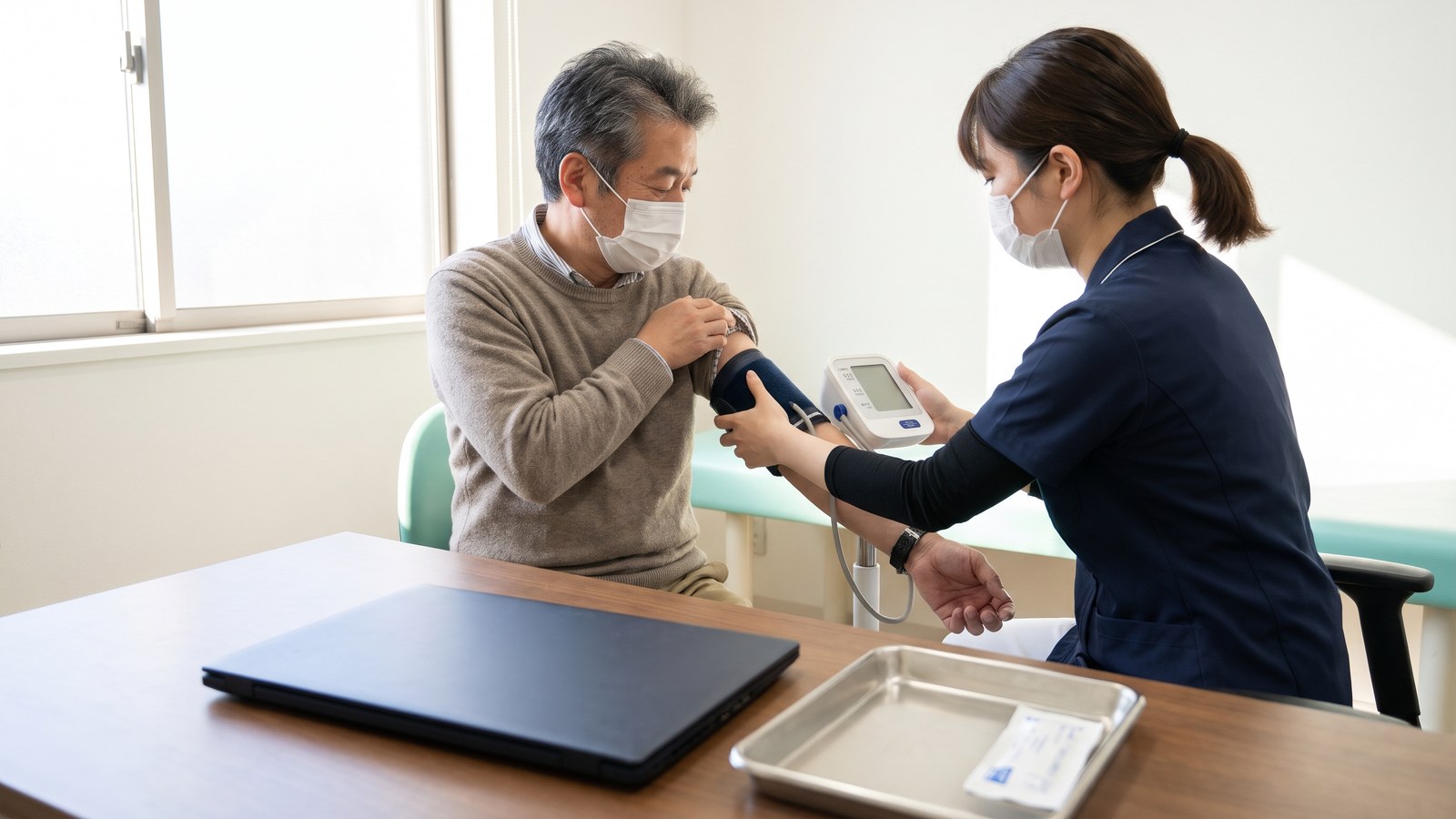
A cost counts when it pays for treatment, not for prevention or appearance. If a cost is far above the usual level for the condition, the excess does not count. This guide is for tax residents of Japan. If you were a non-resident all year, you cannot claim it. If you moved to or from Japan during the year, only costs you paid while you were a resident count.
Counts
- Doctor and dentist fees for treatment, in Japan or abroad
- Medicine for treatment, including cold medicine from a pharmacy
- Hospital stays, including hospital meals
- Train and bus fares to see a doctor
- Pregnancy checkups and childbirth
- Licensed massage, acupuncture or judo therapy for an illness or injury
- LASIK eye surgery
Generally does not count
- Health checks, unless one finds a serious illness that is then treated
- Vitamins and products for prevention or general health
- Cosmetic treatment, and braces only to improve appearance
- Everyday glasses, unless a doctor has you wear them as treatment
- Car gas and parking, and taxis when trains or buses are available
- A private hospital room chosen for convenience, and gifts to doctors
How the amount is calculated
Your deduction is what you paid, minus insurance payouts, minus ¥100,000.
- 1. Add up the medical costs you actually paid from January 1 to December 31.
- 2. Subtract insurance payouts that cover those costs.
- 3. Subtract ¥100,000, or 5% of your total income if your total income is under ¥2 million.
- 4. The result, up to ¥2 million, is your deduction.
Payouts to subtract include the high-cost medical expense benefit (kogaku ryoyohi) and the childbirth lump-sum allowance (shussan ikuji ichijikin) from Japanese health insurance. You also subtract hospital benefits from private medical insurance. Subtract each payout only from the cost it covers.
Do not subtract payments that replace lost pay, such as the sickness allowance (shobyo teatekin) or maternity allowance (shussan teatekin). If a payout is not fixed when you file, use the expected amount and correct it later.
For an employee with no other income, total income means pay after the employment income deduction, not gross pay.
Family members and costs paid abroad

You can include costs you paid for your spouse or other relatives who share your budget (seikei o itsu ni suru). They do not have to live with you. For example, a parent who lives on money you send regularly can count.
The relative does not need to be your dependent, and their own income does not matter. The person who actually paid a cost claims it. If the relative lives abroad, whether you share a budget depends on the facts. Keep records that show you paid.
Fees paid to doctors abroad count, for example during a trip home. Convert each payment into yen at the bank's mid-rate (TTM) on the day you paid.
Example: Maria's claim for 2026
In this example, Maria paid ¥380,000 in health costs, and her deduction is ¥200,000.
Maria is a tax resident and an employee in Tokyo. Her total income for 2026 is ¥2 million or more. Her son lives with her. No other insurance covered these costs.
| Item | Amount |
|---|---|
| Her hospital stay in Japan, including hospital meals | ¥200,000 |
| Payout from her private medical insurance for that stay | −¥50,000 |
| Her son's clinic visits and prescribed medicine | ¥60,000 |
| Her son's treatment on a trip home: US$600 × ¥150 (TTM) | ¥90,000 |
| Her health check, ¥30,000, with no illness found: not counted | ¥0 |
| Costs counted after the payout | ¥300,000 |
| Threshold: her total income is ¥2 million or more | −¥100,000 |
| Medical expense deduction | ¥200,000 |
If Maria's top income tax rate is 20%, the deduction cuts her national tax by about ¥40,840. That is ¥40,000 of income tax (¥200,000 × 20%) plus ¥840 of special income tax for reconstruction (2.1% of ¥40,000). At the standard 10% rate, her resident tax (juminzei) on 2026 income falls by about ¥20,000. This is only an estimate. It assumes all of the deduction falls in the 20% band and nothing else changes.
How to claim: a tax return, not your employer
Your employer cannot include this deduction in your year-end adjustment, so you claim it on a final tax return.
With the return, you submit the medical expense statement (iryohi kojo no meisaisho), which lists your payments. You do not attach receipts. Keep them for five years after the filing deadline, or after the date you file if that is later. The tax office (zeimusho) may ask to see them.
For tax year 2026 (Reiwa 8), the filing period is February 16 to March 15, 2027. If you file only to get a refund, you can file from January 1, 2027, for five years. Your return also counts as your resident tax report, so the deduction lowers that tax too.
If you file, you must also report side income of ¥200,000 or less.
Japan's self-medication tax system is a separate option. You can use it if you had a qualifying health check or vaccination in the year, such as your employer's annual health check. You can deduct what you spent on qualifying over-the-counter medicines above ¥12,000, up to ¥88,000. Receipts show which products qualify.
For example, ¥40,000 of qualifying medicines gives a ¥28,000 deduction. You must choose either this option or the regular deduction for the year, and you cannot switch after filing.
Common mistakes
- Forgetting to subtract insurance payouts. This includes payouts from travel insurance for treatment abroad.
- Counting health checks and supplements. A health check counts only if it finds a serious illness that is then treated.
- Using the date of treatment. What matters is the date you paid. A bill you pay in January counts in the new year.
- Claiming both options. You choose the regular deduction or the self-medication option, not both.
What you can do yourself, and where you need help
If your costs are straightforward, you can claim this deduction yourself:
- Keep every receipt, and note who was treated, the date and the amount.
- Subtract insurance payouts, and check the ¥100,000 threshold.
- Use the NTA online tool, which is in Japanese, with its English input guide.
Get help with costs for a relative abroad, foreign-currency bills, payouts not yet fixed, past years, or other income such as RSUs.
What changes when a tax accountant handles it
Komatsu CPA & Tax Accounting Office helps individuals only, with Japanese tax only, and offers no calls. Our service runs by email in written English. Once you engage us, we:
- Sort your receipts into costs that count and those that do not, and explain the result in writing.
- Convert foreign-currency bills into yen, and subtract each insurance payout from the cost it covers.
- Check whether the self-medication option gives you a larger deduction.
- Prepare the statement and the Japanese return, and send you an English summary to approve. Then we sign and file the return.
Take an employee with one withholding slip (gensen choshuhyo). For this claim, our English-language service items add up to ¥75,000 (¥48,000 base + ¥9,000 salary + ¥9,000 standard deductions + ¥9,000 medical expense deduction). That is below our minimum, so the fee for one year's return is ¥105,000 (¥115,500 including tax). For a claim like Maria's, the tax saved is less than this fee, so filing yourself may suit you better. This is only an estimate, based on these assumptions.
Frequently asked questions
Can I claim medical costs I paid outside Japan?
Yes, if you paid them while you were a tax resident of Japan. Fees paid to doctors abroad count too. Convert each payment into yen at the bank's mid-rate (TTM) on the day you paid. Subtract any insurance payout that covered the cost.
My spouse and I both paid medical bills. Who claims them?
Each of you claims the costs you actually paid. You can include costs you paid for your spouse, even if your spouse has an income, as long as you share a budget.
Do I need to attach my receipts?
No. You attach the medical expense statement instead. Keep your receipts for five years after the filing deadline, or after the date you file if that is later. The tax office may ask to see them.
Can I still claim for past years?
Generally yes, within five years. A refund return can be filed for five years from January 1 of the next year. For example, the window for tax year 2021 closes on December 31, 2026, and the one for tax year 2022 on December 31, 2027. If you already filed a return for that year, you can generally request a correction within five years.
Not sure which medical costs you can claim?
Yuma Komatsu is a Japanese CPA and licensed tax accountant. We prepare, sign and file your return. We work by email in written English. Our tax accountant does not speak English, and we do not offer calls.
Sources
- National Tax Agency (NTA) No.12009: Filing returns for refund
- NTA: 2025 Income Tax and Special Income Tax for Reconstruction Guide, pages 27 and 39 to 41 (deduction for medical expenses)
- NTA: You can create a Final Tax Return at Home! (English input guide for the online tool, 2025 edition)
- NTA Tax Answer No.1120 (in Japanese): medical expense deduction and its Q&A
- NTA Tax Answer No.1122 (in Japanese): costs that count and its Q&A (health checks, eye treatment, costs paid abroad)
- NTA Tax Answer No.1124 (in Japanese): pregnancy and childbirth costs
- NTA Tax Answer No.1126 (in Japanese): hospital stays
- NTA Tax Answer No.1128 (in Japanese): dental treatment
- NTA Tax Answer No.1129 (in Japanese): the self-medication tax system
- NTA Tax Answer No.1131 (in Japanese): choosing the self-medication option or the regular deduction
- NTA Tax Answer No.1900 Q&A (in Japanese): reporting income of ¥200,000 or less when you file
- NTA Tax Answer No.2020 (in Japanese): final tax return
- NTA Tax Answer No.2030 (in Japanese): refund returns
- NTA Tax Answer No.2260 (in Japanese): income tax rates
- NTA Q&A (in Japanese): medical costs paid for a mother who lives apart
- NTA Q&A (in Japanese): medical costs paid for a spouse with an income
- NTA Q&A (in Japanese): medical costs paid for a relative who is not your dependent
- NTA Q&A (in Japanese): an insurance payout larger than the cost it covers
- NTA Q&A (in Japanese): when the five years for a refund claim start and end
- NTA (in Japanese): main national tax due dates
- Income Tax Act, Articles 73, 120, 122, 165 and 190 (in Japanese)
- Order for Enforcement of the Income Tax Act, Articles 207 and 258 (in Japanese)
- Income Tax Basic Circular 2-47 (in Japanese)
- Income Tax Basic Circular 73-1 to 73-10 (in Japanese)
- Act on Special Measures Concerning Taxation, Article 41-17 (in Japanese)
- Local Tax Act, Articles 35, 314-2, 314-3 and 317-3 (in Japanese)
This article is general information based on rules in force as of November 11, 2026. It is not advice for your situation.